“He needs to pay attention, turn in his homework, and sit still in class,” was the phrase my mom most commonly heard from my teachers in 1st, 2nd, and 3rd grade. Over time, my focus didn’t improve; if anything, it only got worse. “He needs to stop talking and distracting classmates.” In addition to what previous teachers had said, this became the new template teachers used to tell my mom during parent-teacher conferences.
They often had long and hefty conversations about me, how I would be distracted but still able to participate in class. Even with the annual state testing in every grade, I never received a “below average” score. Math and history, the concentrated sections of class, kept me the most aloof.
6th grade saw the beginning of something new. After running along on pure luck and raw discernment, an opportunity was presented to me—a solution for my increasingly bothersome problem of dislike and annoyance with class time: the opportunity to join a new and upcoming student band.
This was a weekly occurrence that required students to skip a portion of the regularly scheduled class. Luckily for me, it was during the majority of my class’s math section. Students who were struggling with math and/or had scored a “below average” on the CAASPP were usually allowed to join. That wasn’t an issue for me, but my teacher didn’t want to allow it because, as she said, “You always lose focus and distract others around you.”
This initially bummed me out because I thought I had lost the chance to skip something that, to me, seemed boring and easy. After thinking about it for quite some time, I presented my argument to my teacher.
-“Mrs. Gonzales, if you’re really that worried about my focus and me being a distraction, wouldn’t allowing me to be in the band and not in class remove me as a distraction to both my table mates and you trying to keep me in the room?”
-“Well, yes, but you have to understand that I can’t just allow you to because it’s the ‘easy way’ out.”
-“But if I’m not here, my table mates could potentially learn better without me distracting them, and I won’t be facing any problems since I’m already proficient enough in math.”
-“Okay, Christopher, I’ll let you join. But if you start showing signs of falling behind the rest of the class in math, I will pull you from it.”
Thus began my journey with music.
Initially, nothing was different, with the exception of me returning to class later than the rest of my classmates from lunch. Only now, the last bit of the math teachings were actually captivating. The lack of time spent in class and having less time than normal actually made math seem a little more difficult, which allowed me to hone in so I wouldn’t fall behind.
Along with juggling the interest of learning a new instrument, it was really starting to prove somewhat difficult, but it was doable. In the beginning, it was frustrating. Some math concepts were slipping my mind, and getting the basics of a new instrument just wasn’t clicking.
This brought patience into my life. It made me sit down, for once, to study the things I was learning in class and take time out of my day to really learn how to play the clarinet because it seemed like something worth doing. Eventually, even with less time in class, I was still one of the top students in most subjects. My increased effort in the music class led me to meet new people who were also intrigued by music. Once I grasped the basic concepts of how to play, the rest was easy—learning new music, scales, melodic lines, and much more.
Once the accommodation phase was over, our music teacher told us we were going to present music at a school event. We were going to be accompanied by other groups of students presenting various art forms such as plays, musicals, paintings, and other things I don’t really remember.
This was insanely nerve-racking. The concert was going to be my first time on a stage. Even though I was surrounded by a whole ensemble of students, I was still nervous. I wanted to play the best I ever had—the best I could. So I practiced and practiced until my mouth hurt.
Then the night of the concert arrived. Leading up to it, many of my friends wished me luck and said they would be there to watch me. As a result of the many days and nights of practice, along with support from both friends and staff, the nerves were put to rest. I was confident in myself and in the group as a whole.
Once the performance was over, I was filled with a feeling of fulfillment. I had actually just performed with an ensemble, and it had gone basically perfect. When we were allowed to leave, a couple of my friends and I asked our parents for permission to go get food and celebrate, which they granted.
While eating, the feelings of friendship, accomplishment, and fulfillment from having performed with newfound friends, learning an instrument from scratch, and now celebrating with both old and new friends made me fall in love with the musical scene.Music became a part of my life that followed me through almost everything, even education. I continued to develop my skills in class from 6th grade all the way through my current and final year of high school.
Junior high featured many different opportunities for performing with honor groups and at special events. High school was a different level. I started learning different instruments independently and at school. The difference in the high school level of music was apparent, and the opportunities were much more contrasting. While there were still similar honor groups and events, in high school I was able to travel while performing.
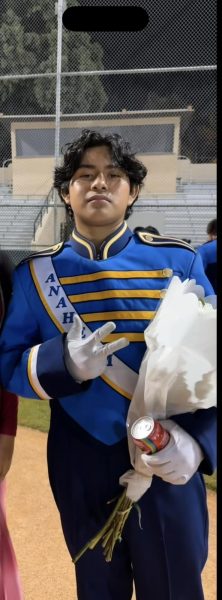
I ended up going on a tour of Europe with students from other schools from all over Southern California. My music comprehension skyrocketed. It was becoming clear that this was something that would stick with me. Consequently, after being so involved in music, I became a teacher to a couple of incoming students during both my junior and senior years of high school. In my junior year, as is the tradition of our band at AHS, I took an incoming student and helped him learn the basics of marching and the new instrument—in this case, a sousaphone/tuba, an instrument that weighs anywhere from 10–25 pounds.
For my senior year, my “increased maturity” led to me receiving a bigger load of responsibility. This year I was in charge of teaching four new kids. I did the best I could: taking time to practice with them after school when they asked for it, running through basic and advanced scales, practicing show music, and learning fun fanfares along with famous melodies.Now, as the year is close to ending, they are proving themselves to be some amazing players. I’m extremely proud of them and how far they’ve come—from being shy and immature to being flamboyant and still immature, but with moderation mixed in with foolishness.